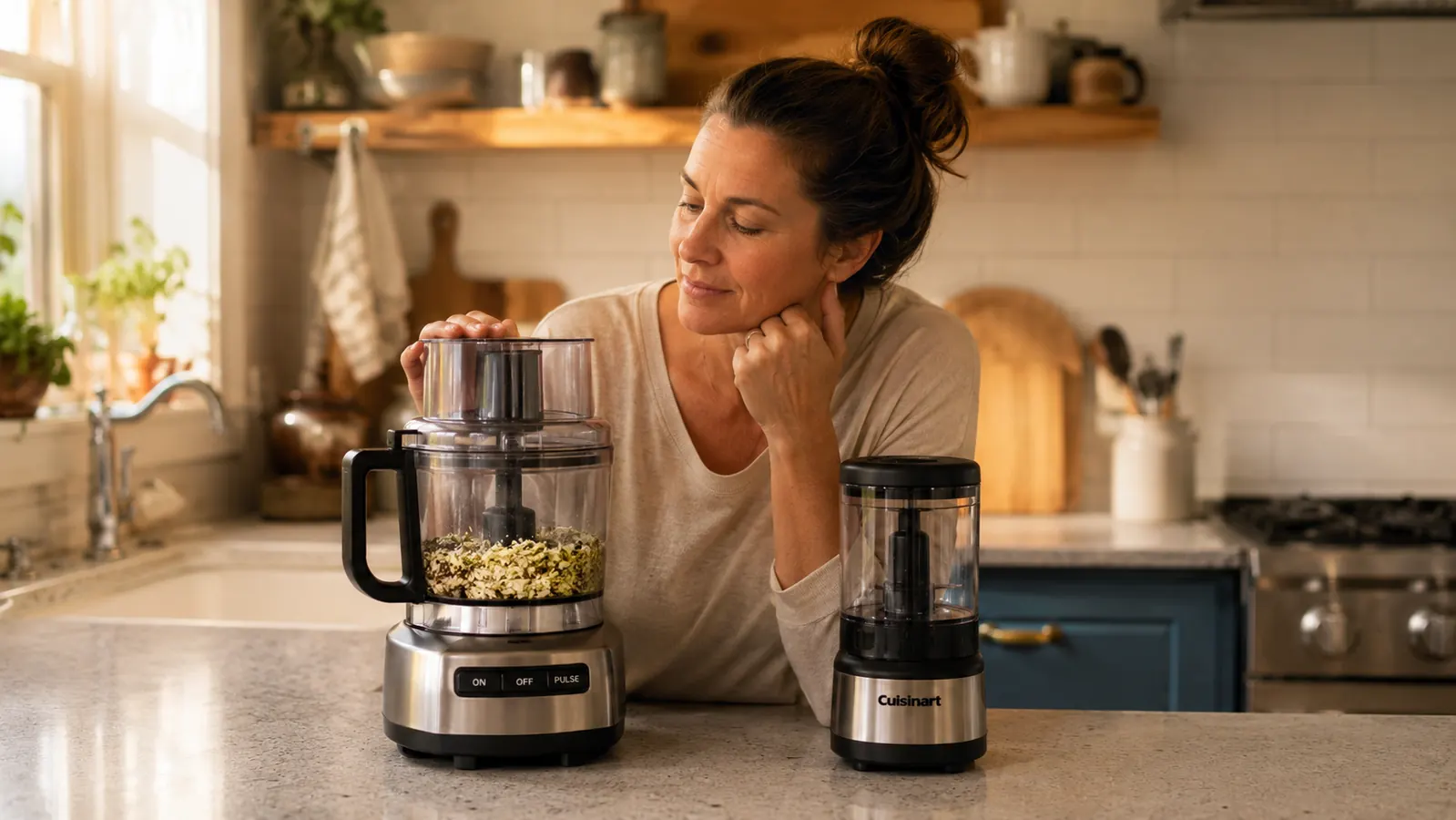
Short answer, if you're cooking real dinners for a family most nights, the KitchenAid 7-Cup Food Processor is the one that earns its spot on three feet of usable counter. I've had it running in my galley kitchen since January, and seven months in, the gap between it and a small mini chopper comes down to one thing: how much food you can actually process before you have to stop and empty the bowl.
I'm not writing this to talk anyone out of a mini chopper. We owned one for almost two years before the KitchenAid, and it did its job for small tasks. Paul still keeps his eye on it in the cabinet like he half expects me to say the bigger machine was a mistake. It wasn't, but I want to be honest about where the little one still holds its own, because this isn't a hit piece.
How I Actually Tested Both
The food processor has been in daily or near-daily rotation since January, which gives me seven months of real dinners to judge it by, onions for taco night, shredded cheese, hummus, pie dough, coleslaw for Sunday cookouts. I didn't buy a second mini chopper to run in parallel. We already owned one, a basic single-button model that lived in our kitchen for almost two years before the KitchenAid replaced it as our go-to, so I know exactly what its limits are from lived experience, not a spec sheet.
So this comparison leans on seven months of hands-on time with the food processor against nearly two years of hands-on time with the mini chopper we already owned. That felt more honest than pretending I ran a fake side-by-side test I didn't actually do. Where the two overlap, I'll say so plainly. Where they don't, I'll tell you which one actually got used and which one got shoved to the back of the cabinet.
| Spec | KitchenAid 7-Cup Food Processor | Mini Chopper |
|---|---|---|
| Work Bowl Capacity | 7 cups, processes a full onion, block of cheese, or double batch of hummus in one pass | 3 cups, usually needs 2 to 3 batches for the same amount of food |
| Feed Tube | 2-in-1 feed tube lets you drop in whole or halved vegetables for slicing and shredding | No feed tube, everything has to be pre-cut into small pieces before it goes in |
| Speed Control | 3-speed dial plus pulse, so you can control texture from rough chop to fine puree | Single speed pulse-only button, one texture setting for everything |
| Attachments Included | Slicing disc, shredding disc, and multipurpose chopping blade, all included | One fixed chopping blade, no discs, no slicing or shredding option |
| Blade and Disc Storage | All-in-one storage case keeps blades and discs together in one spot | Single loose blade that rattles around in a drawer between uses |
| Work Bowl Material | BPA-free polycarbonate work bowl, dishwasher-safe | Small plastic bowl, dishwasher-safe |
| Footprint on a Small Counter | Roughly the footprint of a stand mixer base | About the size of a coffee mug, tucks anywhere |
| Current Price | Check today's price on Amazon | Budget-friendly |
Where the KitchenAid 7-Cup Food Processor Wins
The 7-cup bowl is the whole story for us. On a Tuesday, that's an onion, two carrots, and a block of cheddar going through in one pass instead of three separate rounds of scraping the mini chopper's bowl clean between each ingredient. I bought this in January because I was tired of chopping the same onion in four separate loads for a pot of chili, and that single change has probably saved me fifteen minutes on the nights I'm making anything with more than one vegetable in it.
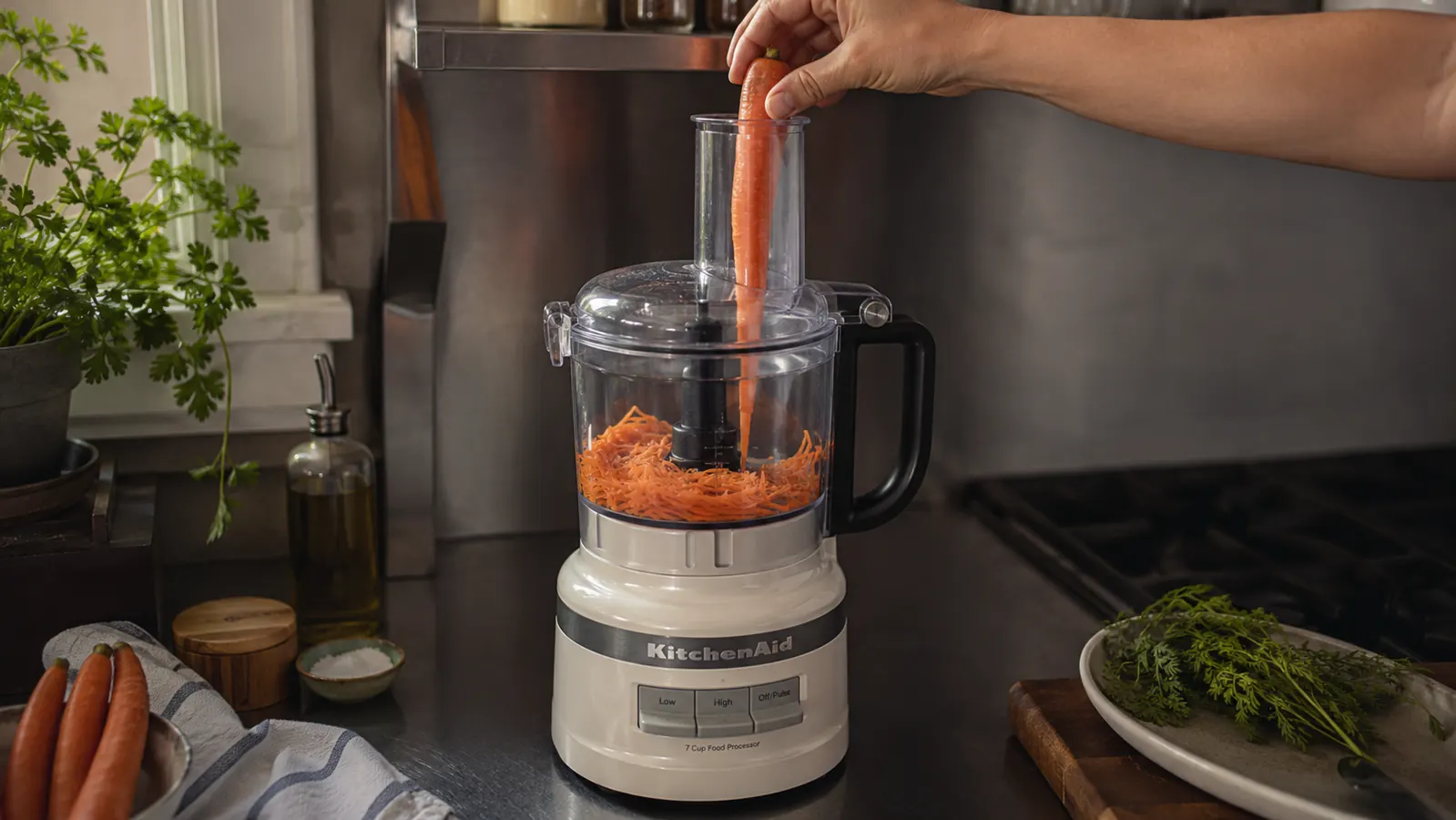
The feed tube is the other feature I didn't expect to lean on this hard. I wrote about this in more detail in my seven-month review of the food processor, but it matters even more once you put it next to a machine that has no feed tube at all. Being able to drop a whole carrot or a halved zucchini straight in and get even shredded or sliced pieces out, without pre-cutting everything into chunks first, cuts real prep time off a weeknight dinner, not just theoretical time.
The disc system matters more than I expected too. Between the slicing disc for cucumbers on taco night and the shredding disc for coleslaw and hash browns, having those built in means I'm not pulling out a box grater and adding another thing to wash. The mini chopper's single fixed blade covers chopping fine, but it can't slice a potato or shred a block of cheese, full stop. If you're trying to consolidate what you reach for on a busy night rather than add another gadget to the pile, the extra attachments here are doing real work.
Where the Mini Chopper Wins
I'll give the mini chopper its due, because pretending it has no advantages would make this whole comparison pointless. It's small enough to live in a single cabinet shelf without displacing anything else, and for two years that mattered a lot on our three feet of usable counter. If you're mincing a single clove of garlic or making a small batch of pesto for one, pulling out the big food processor and washing four separate pieces afterward is genuinely overkill.
The price gap is real too. A basic mini chopper typically runs at a budget price point, which is a fraction of what the food processor costs, and for someone who cooks for one or two people and rarely needs more than a cup of chopped onion at a time, that lower price buys you almost everything you'll actually use. It's also lighter and easier to pull out for a thirty second job, since there's no bowl, lid, and disc combination to assemble first, just the base and the blade.
Cleanup on the mini chopper is faster too, purely because there's less of it. One small bowl and one blade go in the dishwasher, done. The food processor has more pieces, the bowl, the lid, the pusher, and whichever disc you used, and while all of it is dishwasher-safe, it's still more to load and unload than a single-piece mini chopper. If your kitchen only ever needs to process a small amount of food at a time, that simplicity is a legitimate reason to stick with the smaller machine.
Tired of chopping the same onion three separate times just to fit it in a tiny bowl?
That's the exact problem the 7-cup work bowl solves. The KitchenAid Food Processor handles a full onion, a block of cheese, or a double batch of hummus in one pass, with a feed tube so you're not pre-cutting everything by hand first. See today's price and current availability before you decide.
Amazon Check Today's Price on Amazon →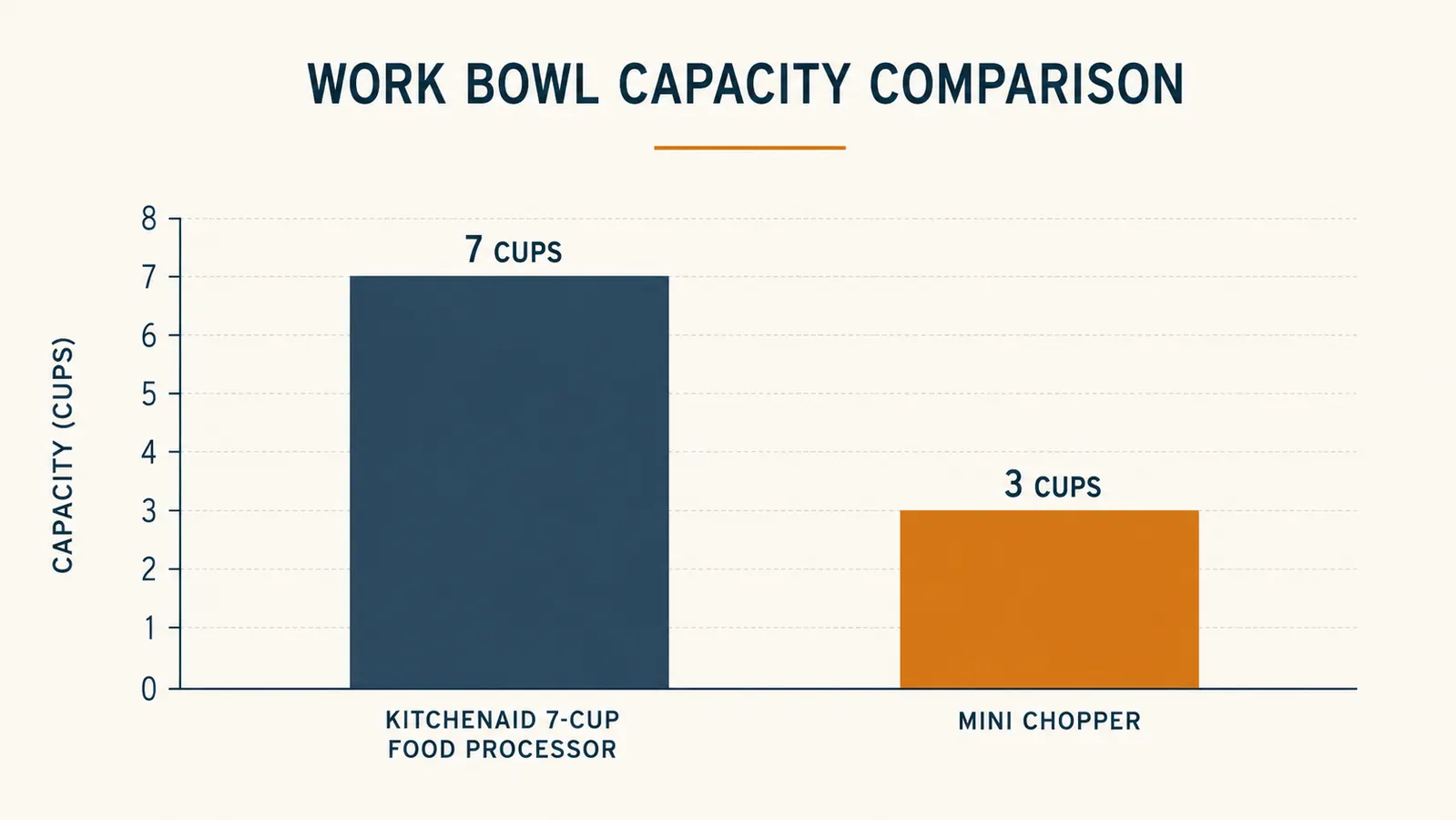
Capacity and Prep Time in Real Terms
Cup measurements on a spec sheet don't mean much until you're standing at the counter with dinner half-planned. Seven cups in the KitchenAid bowl means I can shred a full head of cabbage for coleslaw and still have room to add carrots without it overflowing. Three cups in the mini chopper means the same coleslaw comes out in two or three separate rounds, with a pause to dump the bowl into a mixing bowl each time so you don't overfill it and end up with cabbage stuck under the blade instead of chopped by it.
That batching problem is exactly why our old mini chopper stopped being the default for anything beyond a single ingredient. It worked fine for one small task at a time, but once I started cooking meals with three or four vegetables that all needed processing, the math of emptying and reloading the bowl over and over stopped making sense. If you're cooking for one or two people and rarely process more than a cup of anything at once, three cups may never feel small to you. If you're feeding a family and prepping more than one vegetable a night, you'll hit that ceiling within the first week, the same way we did.
Noise, Cleanup, and Storage
Neither of these is silent, but the difference is smaller than you'd think. The food processor's motor runs at a noticeably higher pitch than the mini chopper for the few seconds it takes to shred or slice, since it's moving through more food at once, but it's over quickly and it's not a sound that carries the way a blender does. The mini chopper is quieter simply because it's doing less work at a time, a handful of pulses instead of a sustained run.
Storage is where they genuinely diverge, and it's not the direction you'd guess from size alone. The mini chopper is smaller, but its single loose blade rattles around in a drawer and I've nicked a finger reaching past it more than once. The food processor's all-in-one storage case keeps the slicing disc, shredding disc, and chopping blade together in one spot, so I'm not hunting through a drawer for the right piece on a night when I'm already behind on dinner. On balance, I'd rather store the slightly bigger machine that keeps its parts organized than the smaller one that scatters its single blade loose.

Price and Long-Term Value
I'm the one who checks the receipts in our house, and I don't buy a second small appliance without doing the math on whether it earns its keep. The food processor costs more upfront than a mini chopper, there's no getting around that, so this isn't really a comparison decided on which one is cheaper. It's decided on which one you'll still be reaching for a year from now instead of leaving in the cabinet.
For us, that math favors the KitchenAid because it replaced the mini chopper as our daily-use appliance almost immediately after it arrived in January. The mini chopper still gets pulled out for the occasional single clove of garlic, but it's no longer the machine standing between me and a finished dinner on a busy weeknight. A cheaper appliance that sits mostly unused after the novelty wears off is worse value than one that costs more and earns its counter space every single week. Check today's price before you decide, since it does shift with promotions.
The mini chopper is a fine tool for a single clove of garlic. It was never built for a real dinner with four vegetables in it.
Who Should Buy Which
If you're cooking dinner most nights for three or more people, and your prep list usually includes more than one vegetable, the KitchenAid 7-Cup Food Processor is the one I'd point you toward. The larger bowl and the feed tube solve the exact problem that pushed me to buy it in January, standing at the counter chopping the same onion in three separate loads because the bowl I had was too small. I put together 10 reasons a food processor speeds up dinner prep if you want the fuller case for making the switch at all, regardless of which one you land on.
If you're cooking for one or two people, rarely process more than a cup of anything at a time, and your budget is the deciding factor, the mini chopper's lower price and smaller footprint are legitimate reasons to stick with it. Just go in knowing you'll likely be running multiple batches once your household grows or your meals get more involved, the way ours did once I started cooking for four every night instead of two.
If you're prepping dinner for a family, don't let a tiny bowl slow you down every single night.
Seven months of near-daily use have made the case for us. If your kitchen looks anything like ours, tight counter, real appetites, and no patience for a third batch of chopped onion, it's worth checking today's price while it's still in stock.
Amazon Check Today's Price on Amazon →