
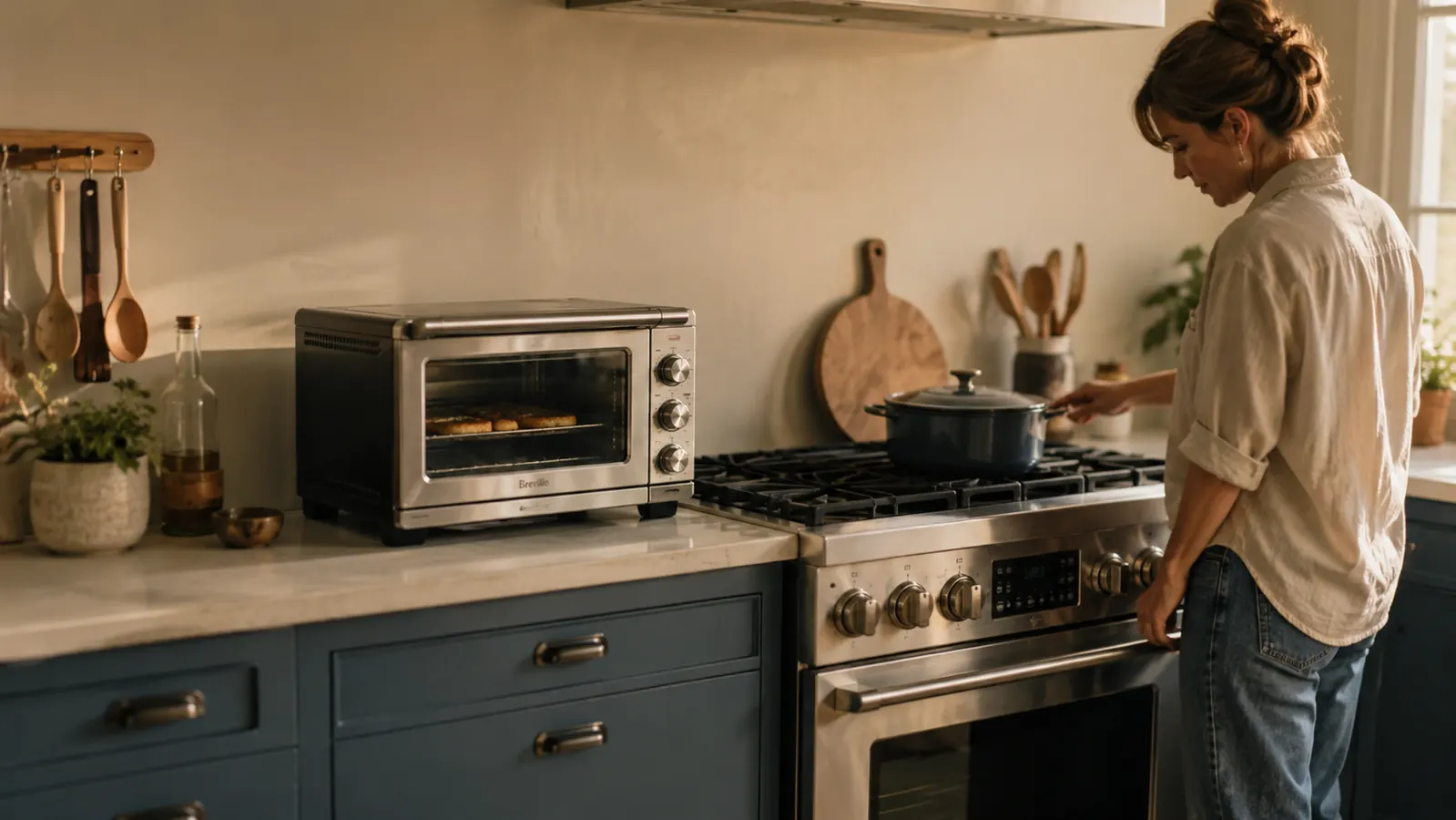
Short answer, if you're feeding a family of four on an ordinary weeknight and you don't want to heat up the whole house just to reheat a slice of pizza, the Cuisinart Custom Classic Toaster Oven Broiler earns its spot faster than flipping on our full-size oven. I bought this toaster oven back in February, and six months of near-daily use later, the gap between the two comes down to preheat time, portion size, and how much heat you're willing to dump into a small kitchen for a job that doesn't need it.
I'm not telling anyone to rip out their range. Paul and I still use our full-size oven every week, especially on Sundays when I'm cooking a real dinner for all four of us, Jack, Nora, Paul, and me. This comparison is about which appliance you should actually reach for on a plain Tuesday, and after six months of testing that exact question in my own galley kitchen with three feet of usable counter, I have a real answer instead of a guess.
How I Actually Tested Both
I've had the Cuisinart running most weeknights since February, so this isn't a first-impressions comparison built off a single dinner. It's six months of actual use, reheated leftovers, Saturday morning bagels for the kids, broiled salmon when Paul wants something quick after work, and the occasional tray of chicken thighs when I don't want to commit the whole kitchen to dinner. Our full-size oven has been in this house since we moved in nine years ago, so I know its quirks about as well as I know my own kids' moods before dinner.
So this comparison leans on real side-by-side use in my own kitchen, not two spec sheets I've never actually cooked from. When I say the toaster oven preheats faster, that's a timer I've watched more nights than I can count standing at the stove, not a number I copied off a box.
| Spec | Cuisinart Toaster Oven Broiler | Full-Size Oven |
|---|---|---|
| Interior Capacity | 0.5 cu. ft., fits a 9-inch pizza or 4 slices of toast | Roughly 5 cu. ft., fits a full sheet pan or a holiday turkey |
| Preheat Time | About 5 minutes to reach 450 degrees | 12 to 15 minutes to reach the same temperature |
| Wattage | 1800W | Roughly 3,000 to 5,000W depending on the range |
| Countertop Footprint | Sits on 3 feet of counter, about the size of a large bread box | Built into the wall, no counter space used at all |
| Kitchen Heat Output | Barely warms the room during a 20-minute broil | Heats the whole kitchen within 10 minutes of use |
| Broil Function | Broil element sits inches from the food for a fast, even sear | Broiler drawer sits further from the food, slower to brown |
| Best For | Reheating, toasting, small-batch baking, weeknight sides | Large roasts, multiple sheet pans, holiday-size cooking |
| Cleanup | Removable crumb tray wipes clean in under a minute | Self-clean cycle runs 3 to 4 hours and heats up the house |
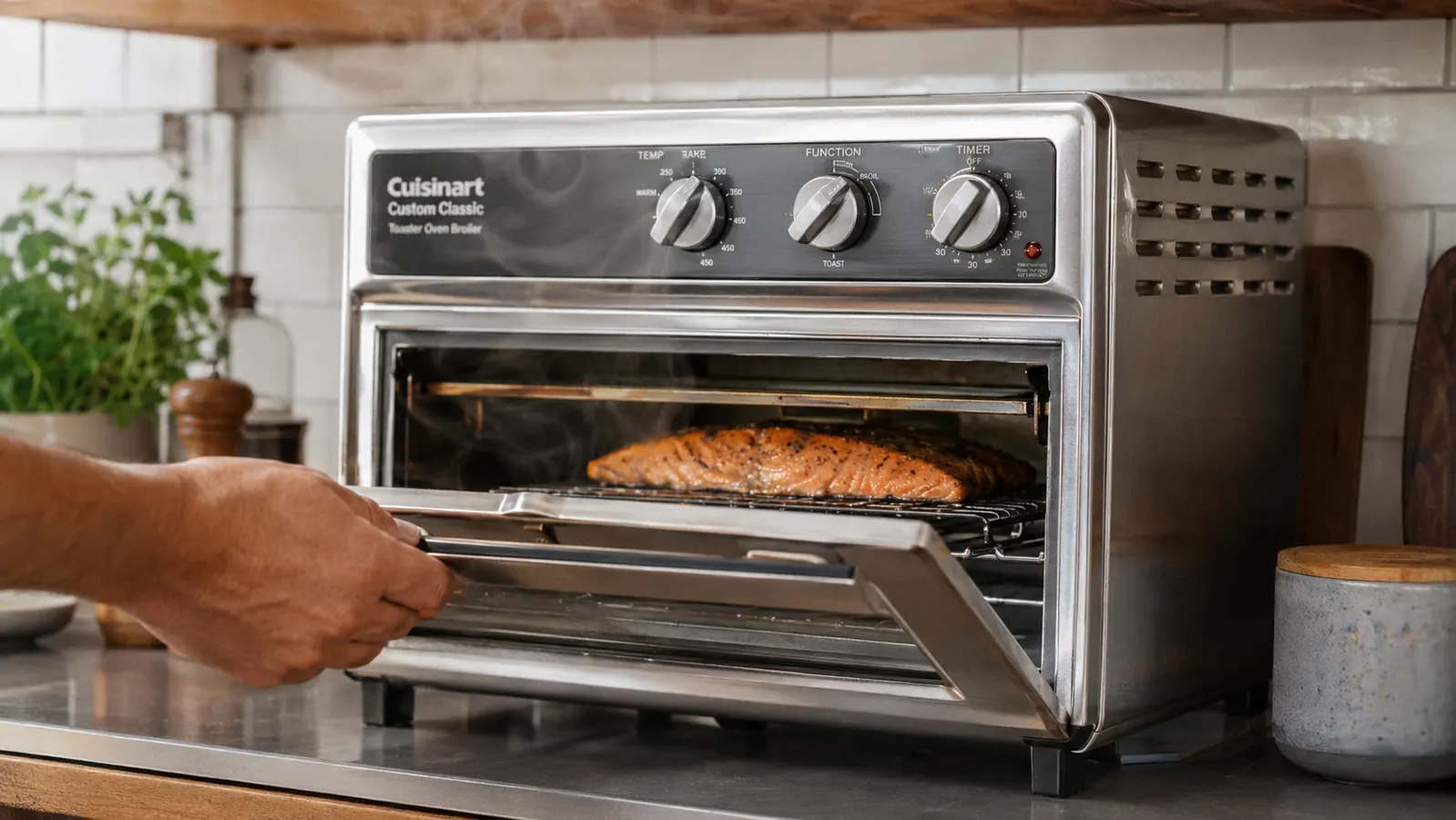
Where the Cuisinart Toaster Oven Wins
On a weeknight, five minutes to reach 450 degrees is the whole ballgame. I used to flip on the full-size oven the second I walked in the door, before I even knew what we were having, because it takes 12 to 15 minutes just to hit temperature. With the Cuisinart, I can decide dinner, season it, and have it in the oven before the full-size range would have even finished preheating. That adds up to real minutes back most nights, and on a Tuesday with homework and two kids underfoot, minutes matter.
The other place it wins is heat you don't want. Running the full-size oven for 20 minutes in a small galley kitchen with three feet of counter and not much airflow makes the whole room miserable by 6pm in July. The Cuisinart puts off noticeably less ambient heat for the same broiled salmon or reheated leftovers, and that mattered more to me than I expected going into February. I wrote up the fuller day-to-day case for it in my six-month review of the Cuisinart toaster oven, but the short version is that it's simply the right tool for small jobs.
Cleanup is the third win, and it's not a small one. The full-size oven's self-clean cycle takes 3 to 4 hours and turns the kitchen into a sauna while it runs, so I only do it a handful of times a year. The Cuisinart's crumb tray slides out and wipes clean in under a minute, which means it actually gets cleaned after almost every use instead of getting put off for months.
Where the Full-Size Oven Wins
Capacity is where the full-size oven earns its keep, and it's not close. Five cubic feet against half a cubic foot means a Sunday dinner for four, plus a side dish and a dessert, all cooking at the same time on two racks. The Cuisinart's 0.5 cu. ft. interior fits a 9-inch pizza or a small tray of chicken thighs, but it cannot touch a full sheet pan, let alone a turkey or a lasagna dish big enough to feed everyone with leftovers.
The full-size oven also wins when I'm cooking more than one thing at once. On a Sunday I'll have a roast on the top rack and roasted vegetables on the bottom, timed to finish together. That kind of layered cooking just isn't possible in half a cubic foot of interior space, and I wouldn't try to force it. If your household regularly cooks for six or more, or you host holidays where the oven runs for hours straight, the full-size oven is doing a job the countertop unit was never built for.
It also wins on things that need low, even heat over a long stretch, like a slow-roasted pork shoulder or a big batch of granola. The Cuisinart can technically bake at low temperatures, but I don't trust it to hold steady for three or four hours the way our built-in range does, and I haven't tested it long enough at that duration to vouch for it either way.
Tired of heating up the whole kitchen just to reheat leftovers?
That's the exact problem the Cuisinart solves. Five minutes to preheat, a crumb tray that actually gets wiped clean, and none of the ambient heat that makes a small kitchen miserable in July. See today's price and current availability before you decide.
Amazon Check Today's Price on Amazon →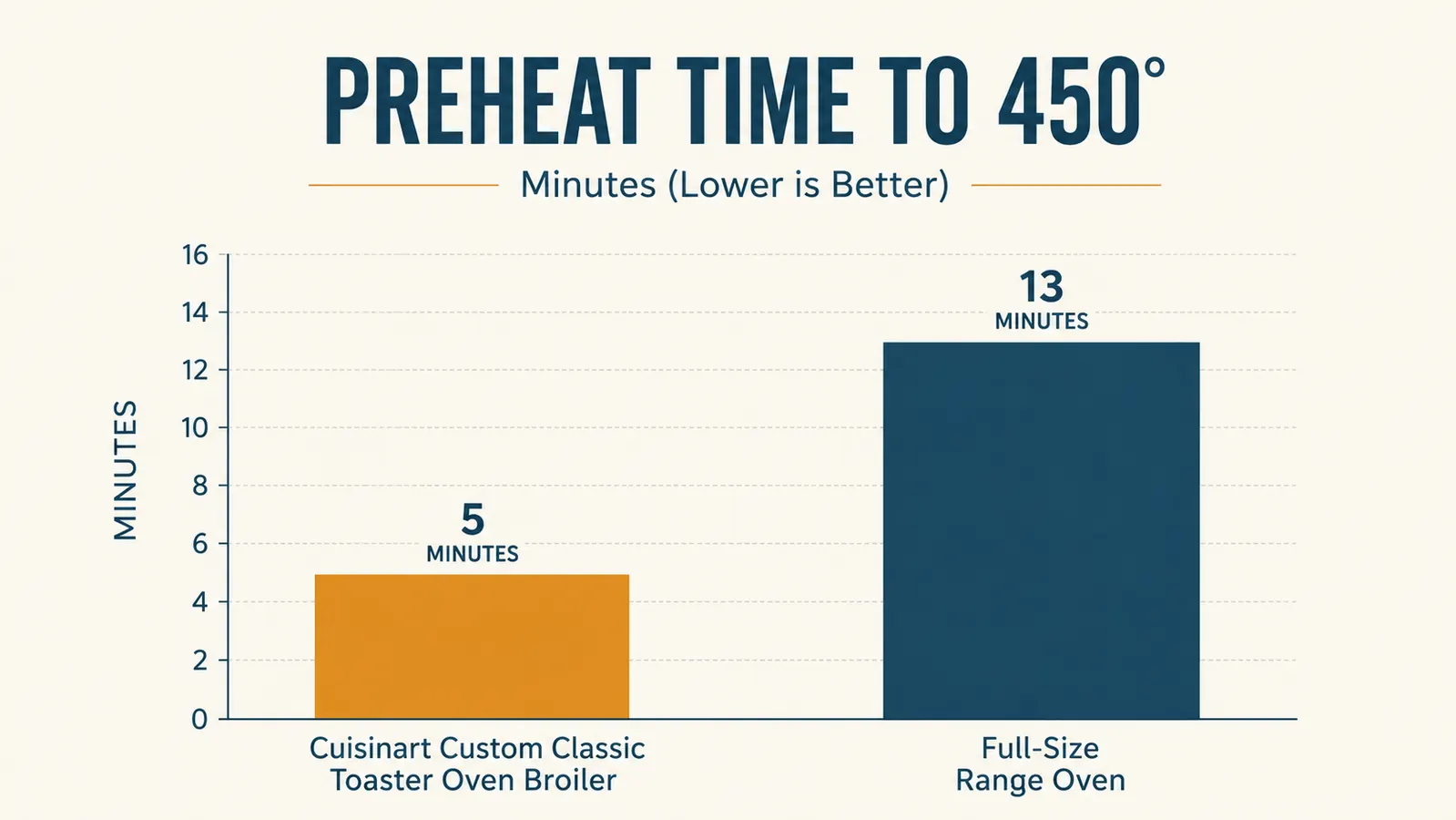
Capacity in Real Terms, Not Just Cubic Feet
Cubic feet on a spec sheet don't mean much until you put actual food inside. Half a cubic foot in the Cuisinart means a 9-inch pizza fits with room to spare, four slices of toast lie flat, and a small tray of chicken thighs for two of us cooks evenly. It does not mean a full dinner for four in one pass. If Jack and Nora are both eating chicken thighs alongside Paul and me, I'm either running the toaster oven twice or moving the job to the full-size oven, and most nights I choose the full-size oven for exactly that reason.
Five cubic feet in the full-size oven means a whole sheet pan of roasted vegetables sits next to a second sheet pan of chicken, or a 9x13 casserole big enough for seconds. That's the ceiling the Cuisinart will never hit, and I don't think it's trying to. It's built for the small, fast jobs that make up most weeknight cooking, toast, reheating, broiling a couple of fillets, baking a small side. For anyone deciding between the two, I laid out the fuller list of everyday wins in 10 reasons a toaster oven earns its counter space.
Energy, Heat, and Cleanup
At 1800 watts, the Cuisinart draws meaningfully less power than our full-size range, which pulls somewhere between 3,000 and 5,000 watts depending on the burner and oven combination running. For a quick reheat or a single tray of food, that's a real difference over a year of near-daily use, even if it's not the kind of number that shows up dramatically on a single month's bill.
The heat difference in the room is the one I notice more than the utility bill, honestly. Running the full-size oven for even 20 minutes in our galley kitchen with three feet of usable counter and not much airflow raises the room temperature noticeably, especially in summer. The Cuisinart, sitting right there on the counter doing the same job for a smaller portion, just doesn't put off that same wall of heat. On a July evening, that's the difference between a comfortable kitchen and one everyone wants to leave.
Cleanup tips the same direction. I run the Cuisinart's crumb tray under the sink after most uses, maybe a minute of my time. The full-size oven's self-clean cycle is a 3 to 4 hour commitment I only make a few times a year, because it heats the kitchen up worse than actually cooking in it does. Neither appliance is spotless without effort, but one asks for a minute at a time and the other asks for an afternoon.

Price and Long-Term Value
I'm the one who checks the receipts in our house, and I don't buy an appliance without asking whether it earns its keep. The full-size oven was already here when we moved in, so there's no separate purchase to weigh against it. The real comparison is whether adding a countertop toaster oven on top of an oven we already own is worth the counter space and the current price, and six months in, my answer is yes, because it's replaced the full-size oven for the majority of our actual weeknight cooking.
The math that convinced me wasn't dramatic. It was six months of not running a 5,000 watt oven for 20 minutes to reheat two pieces of pizza, and not waiting 13 extra minutes on a Tuesday when homework and dinner are both happening at once. I'd tell anyone weighing this purchase to check today's price before deciding, since it does shift with promotions, but the case for adding it alongside a full-size oven, not replacing it, has held up every single week since February.
The full-size oven still runs on Sundays. The Cuisinart runs on every other night in between, and that's most of the year.
Who Should Buy Which
If most of your cooking is small and fast, reheating, toasting, broiling a couple of fillets, baking a single tray of chicken thighs, the Cuisinart Custom Classic Toaster Oven Broiler is the one I'd point you toward. It solves the exact problem that pushed me to buy it in February, a full-size oven that takes too long and heats up too much room for jobs that don't need either. I put together the fuller case in my honest review after six months of real use if you want the unfiltered version, warts and all.
If you're regularly cooking for six or more, hosting holidays, or you need two sheet pans running at once, keep leaning on your full-size oven for those jobs, no countertop unit is going to replace that kind of capacity. The honest answer for most families, including ours, isn't picking one over the other. It's using the Cuisinart for the nightly small jobs and saving the full-size oven for the Sunday dinners and holidays where five cubic feet actually gets used.
Stop heating your whole kitchen for a job that takes five minutes.
Six months of near-daily use have made the case for us. If your weeknight cooking looks anything like ours, small portions, tight timelines, and no patience for a 13-minute preheat, it's worth checking today's price while it's still in stock.
Amazon Check Today's Price on Amazon →