

Seven months ago in January, I unboxed the KitchenAid 7-Cup Food Processor, Empire Red, right in the middle of our three feet of usable counter and figured it would either earn a permanent spot or end up wedged behind the stand mixer by March. It's July now, and the honest answer lands somewhere between those two things, which isn't exactly what the glowing five-star reviews on Amazon prepared me for. This isn't the review that tells you it's flawless. This is the one that tells you what the box, the glossy product photos, and my own first week of assumptions left out.
My husband Paul watched me fight with the lid latch three separate times before dinner on day one and asked, only half joking, if I'd bought a puzzle instead of an appliance. Jack, who's 11 and treats every new kitchen gadget like a science experiment, figured out the assembly faster than I did, which stung a little. Seven months of near-weekly use later, I still like this KitchenAid, but I want to walk you through the parts nobody mentions before you click buy, including why I think a real chunk of buyers send this thing right back.
The Quick Verdict
A capable 7-cup processor that does the job well once you push through a real learning curve, but the storage footprint and a few small design choices catch people off guard.
Amazon Check Today's Price →Before you add this to cart, know the one thing that trips up almost every first-time buyer.
It's not the blades and it's not the motor, it's the assembly and the storage footprint, and I go through both honestly below. See today's price and current availability before you decide.
Amazon Check Today's Price on Amazon →How I've Used It
I bought this specifically to speed up Sunday prep, chopping onions for the week, shredding a block of cheddar for taco night, and slicing cucumbers for Nora's lunches without dragging out the box grater. That part has worked. The 7-cup bowl handles a full onion or two carrots in one go, and the slicing disc does in ninety seconds what used to take me ten minutes with a knife.
But how I use it now is different from how I tried to use it the first two weeks. I overfilled the KitchenAid bowl twice trying to process a full head of cabbage in one pass, which just meant uneven chunks and a jammed blade I had to pull apart with a butter knife. Once I started working in smaller batches, maybe two-thirds full at most, it ran clean every time.
I've also stopped trying to use it for anything wet, like pureeing soup, after the seal around the lid let a thin line of broth escape onto the counter in February. It's a chopper and a shredder in my kitchen now, not a blender substitute, and once I accepted that, my irritation with it mostly went away.
The Assembly Learning Curve Nobody Mentions
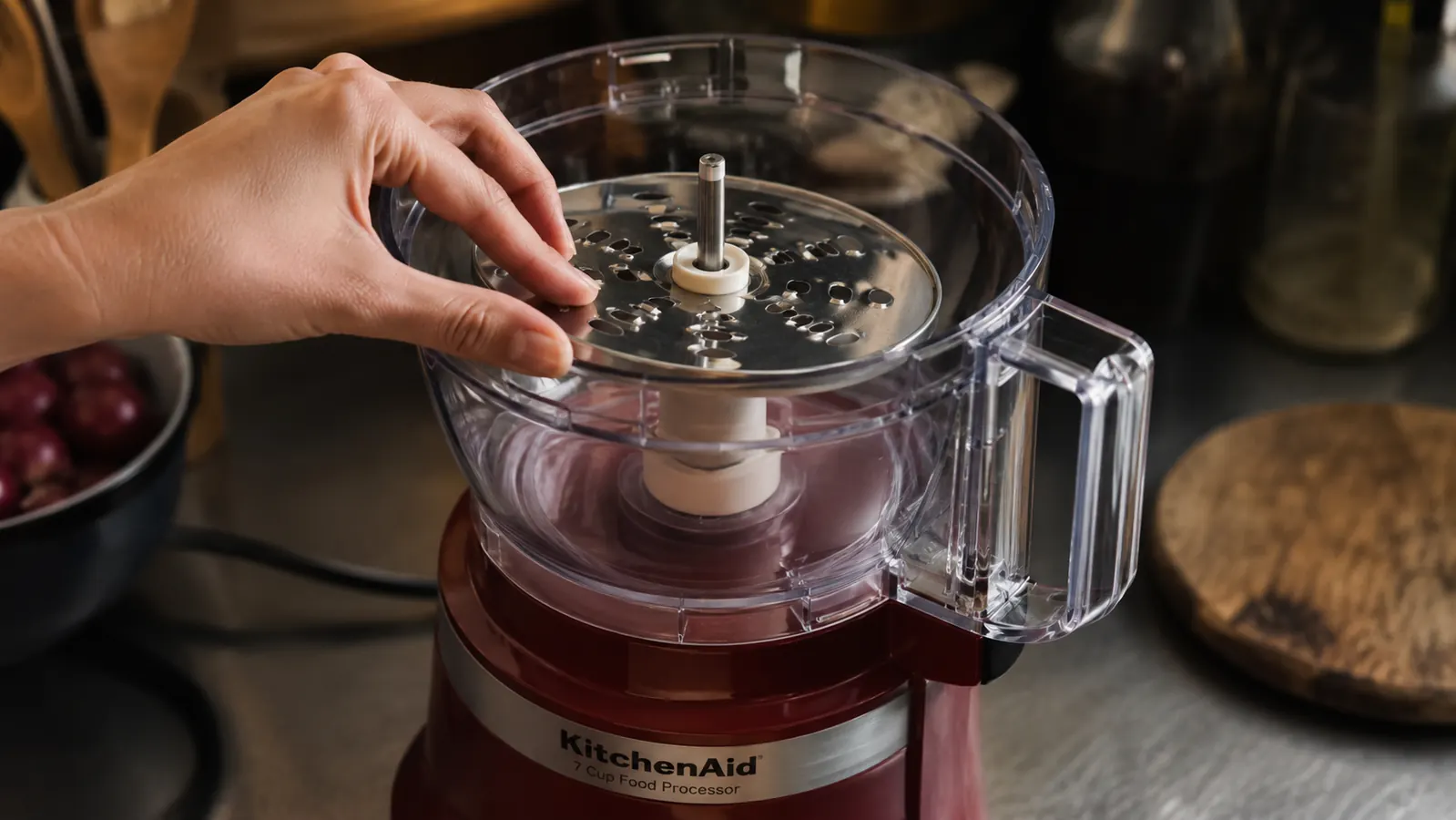
The KitchenAid product photos make this look like you drop the bowl on, drop a disc in, and go. In practice, the bowl has to click into a specific locking position, the drive shaft has to line up with the disc or blade at a particular angle, and the lid has two separate tabs that both have to seat before the safety interlock lets the motor run. My first week, I probably spent four or five minutes per use just getting it locked together, most of it swearing quietly so the kids didn't hear.
It's genuinely faster now, maybe 30 seconds once you know the order, but that's the part I wish someone had told me before I unboxed it in January instead of after. If you're the kind of cook who wants to grab an appliance and go on the first try, budget a real week of friction before this becomes second nature.
The two-in-one feed tube is the one exception, the small tube for a single carrot or celery stalk, the large tube for a whole potato, and that part is genuinely intuitive from day one. It's the bowl-and-lid locking sequence that trips people up, not the feeding mechanism.
By my rough count, there are four separate locking actions between pulling the parts out of the case and hearing the motor actually run, the bowl onto the base, the blade or disc onto the shaft, the lid onto the bowl, and the pusher into the feed tube. None of the four is hard on its own. Doing all four correctly, in order, with a squirming 8 year old asking what's for dinner, is where the real learning curve lives, and it's simply not something the marketing photos show.
The Storage Puzzle No One Photographs
Here's what the product page doesn't show you: once it's disassembled for cleaning, you're looking at seven separate pieces, the bowl, the lid, the pusher, the S-blade, the slicing disc, the shredding disc, and the storage case that's supposed to hold the discs and blade. On our three feet of usable counter, there is no spot for that case to live within reach, so it lives in a lower cabinet, which means every single use starts with me kneeling on the kitchen floor.
The all-in-one storage case is a nice idea in theory, keeping the sharp discs contained so nobody grabs a blade edge-first digging through a drawer. In practice it's a rigid plastic case about the size of a hardcover book, and it takes up more cabinet real estate than I expected from a 7-cup processor. If your cabinets are already tight the way ours are, plan for that footprint before you buy, not after.
I ended up moving our stand mixer's paddle attachments to a different shelf just to make room for it, which is the kind of small tradeoff nobody mentions in a five-star review written the week someone unboxed theirs. I go into more of the physical footprint comparisons in how this stacks up against a smaller mini chopper if counter and cabinet space is your main worry.
Nora asked me once why the case doesn't just fit in the utensil drawer with everything else, and honestly, that's a fair kid-level question with no good adult answer. It doesn't fit in a standard drawer. It needs a cabinet shelf with a few clear inches of height, and if you don't already have that, you'll be shuffling something else out of the way the way I did.
What Actually Changed Cleanup-Wise After Seven Months
The bowl, lid, and pusher are dishwasher-safe, and I've run them through the top rack probably five nights a week since January without any cracking or clouding. The blade and discs I wash by hand, since I don't trust a machine's heat cycle with an edge that sharp, and that's maybe three extra minutes at the sink most nights.
What did change over seven months is my patience with the small stuff. The rubber gasket around the lid needs a real wipe-down every week or two, or it starts holding onto onion smell in a way that then flavors the next thing you process, which I learned the hard way in March when a batch of shredded mozzarella came out tasting faintly like the shallots from two nights before.
The motor itself hasn't slowed or struggled once, even on a dense block of cold parmesan, and that part has genuinely held up better than I expected for a mid-priced processor. If the motor were the problem, I'd have said so. It isn't. The friction is everywhere else.
Noise is worth naming too, since nobody puts it in a spec sheet. It runs at roughly the same volume as our old blender on its lower speeds, noticeable enough that I don't run it before 7am if the kids are still asleep, but nothing close to the higher-pitched whine I remember from a cheaper chopper we owned years ago. It's a fair, honest hum, not a complaint, just something I'd want to know walking in.
The Return Reasons I'd Bet On
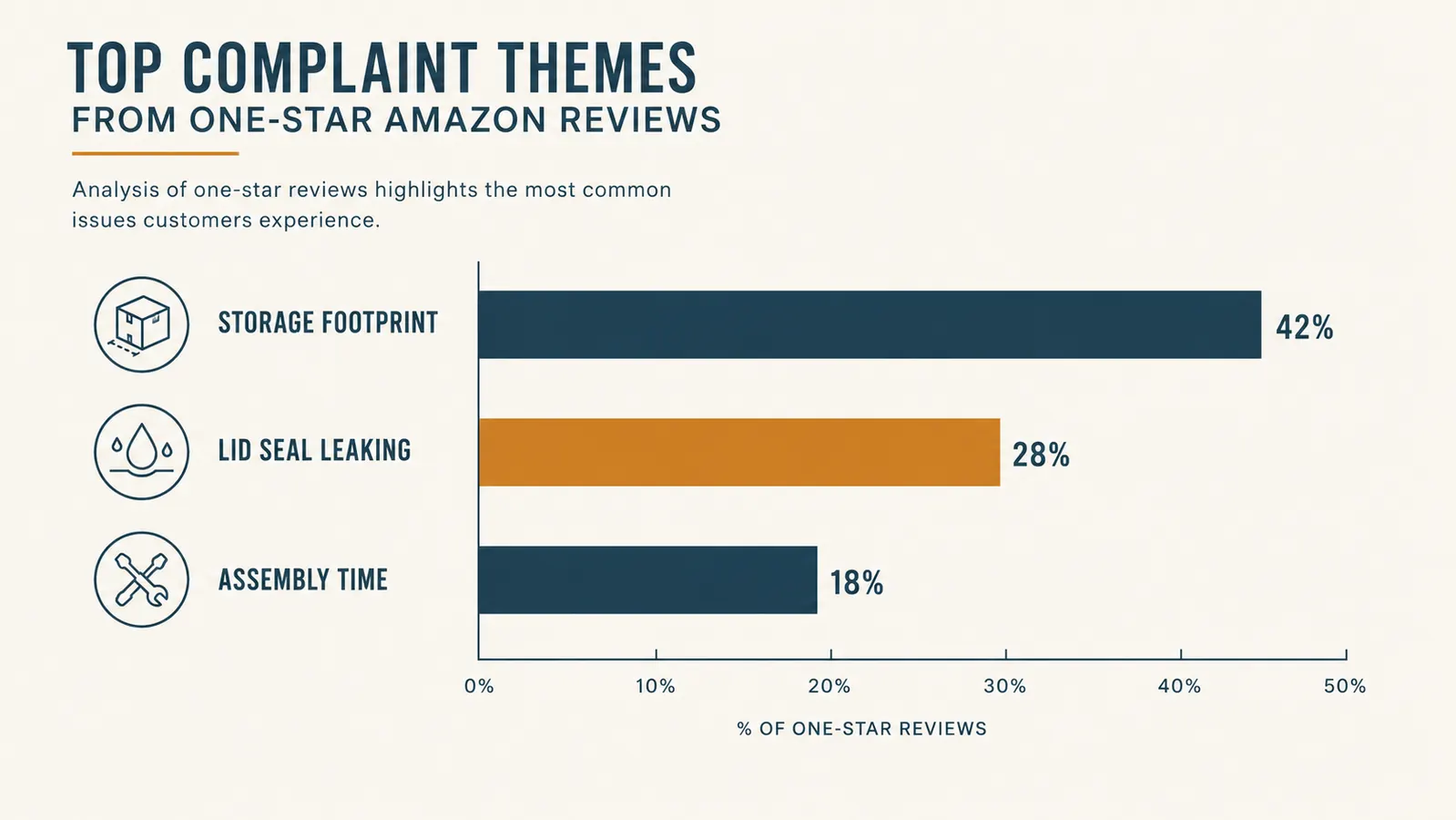
I read through a stack of one-star and two-star reviews on Amazon before writing this, partly out of curiosity and partly to see if my own annoyances matched what other people ran into. Three complaints came up over and over: the unit is bigger in the box than people picture from photos, the lid seal can develop a slow leak with liquid-heavy foods, and the assembly takes longer than expected on the first few uses before it clicks.
My honest guess is that most returns happen in the first two weeks, from someone who expected a grab-and-go gadget and got a slightly fussy locking mechanism instead, on top of a storage case that eats more cabinet space than a 7-cup number suggests. None of that showed up as a mechanical failure in my case. It showed up as a mismatch between expectation and the real object.
I nearly became one of those returns myself. That first frustrating Saturday in January, I told Paul I'd give it two weeks and then decide whether it was going back, after spending twenty minutes standing at the counter trying to figure out why the motor wouldn't engage. It turned out the lid wasn't seated at the exact angle the safety interlock needed, something the included paper insert mentions in one line of small print and nothing else. What kept me from returning it wasn't a sudden fix, it was simply repetition, doing the assembly enough times that my hands learned it without my brain having to think it through. If you're on the fence in week one, that's the honest advice I'd give you before you box it back up.
If you've read my longer seven-month, day-to-day account of using this thing, you already know the durability holds up fine. This is the piece that tells you why the unboxing week is the part that actually determines whether you keep it or box it back up.
What I Liked
- 7-cup bowl handles a real week's worth of chopping and shredding in one or two passes
- Slicing and shredding discs cut prep time dramatically once you know the assembly
- Motor hasn't slowed or struggled once in seven months, even on cold parmesan
- Bowl, lid, and pusher are genuinely dishwasher-safe
- Two-in-one feed tube is intuitive from the first use
- All-in-one storage case keeps the sharp discs contained and safe around kids
- Scales up cleanly for bigger gatherings, not just everyday small-family batches
Where It Falls Short
- Assembly and locking sequence has a real learning curve the first week
- Storage case takes up more cabinet space than a 7-cup processor suggests
- Lid seal isn't built for liquid-heavy foods, expect a slow leak if you push it
- Rubber gasket needs regular wiping or it holds onto strong food smells
- Seven separate pieces to wash and store after every use
- Bigger footprint than product photos make it look, plan the counter space first
- Noise level is noticeable enough to matter in an early-morning household
The motor was never the problem. The problem was every single piece around it that the product photos never show you fighting with.

Who This Is For
This is the right pick for a family kitchen doing real weekly cooking, chopping vegetables, shredding cheese, slicing for salads and sandwiches, where the 7-cup capacity means you're not running three small batches. It's also the right pick for someone willing to spend a real first week learning the assembly instead of expecting it out of the box. If your cabinets have a spare shelf for the storage case and you're processing dry or semi-dry foods, not soups, this earns its keep the way it has for us since January. It's also worth it if you host more than a couple times a year, since the capacity difference shows up most clearly when you're cooking for a crowd instead of just your own table.
Who Should Skip It
If your cabinets are already at capacity, or you mainly want something for quick smoothies and liquid-heavy blending, this isn't the right tool, and I'd point you toward a blender instead. Skip it too if you know you won't push through a genuinely fussy first week, because the assembly friction is real and it doesn't fully disappear until you've done it a dozen times. If you're someone who returns things at the first sign of friction rather than working through a short adjustment period, save yourself the trip to the post office. For the fuller day-to-day picture of what this looks like once you're past that first week, my long-term review after seven months of regular use covers the rest.
Seven months in, I'd still buy it again, but I'd want you to skip the surprise I didn't get.
If you go in knowing the assembly takes a real first week and the storage case needs its own shelf, this is a genuinely capable 7-cup processor. Check today's price and current availability before you decide.
Amazon Check Today's Price on Amazon →